4 hr
Indian Nose Sunrise Hike Over Lake Atitlán
- Entry ticket
- Mobile voucher
- Valid same day
- Free cancellation
Indian Nose Sunrise Hike Tour — Guided Summit Climbs Above Lake Atitlán
Headlamps up the ridge before five, three volcanoes lit at once.
Compare fares, pick the fit — all bookings are mobile-voucher and eligible for free cancellation where shown.
4 hr
4 hr
6 hr
For the indian nose sunrise hike tour, the official bookable options I could verify are tour variants rather than separate attraction ticket tiers. The most useful split for a first-time visitor is between a summit sunrise hike and a combined hike with extra stops, with the 30 GTQ trail fee still separate from tour pricing.
|
Top pick Summit sunrise hike Direct Indian Nose summit access |
Summit + Sacred Hunters Cave Hike plus cave stop | |
|---|---|---|
| view/access | Summit sunrise overlook | Summit sunrise overlook |
| height/areas included | Indian Nose summit only | Indian Nose summit plus cave area |
| access method | Guided hike | Guided hike with transfer |
| wait time | Timed pickup window | Timed pickup window |
| what's included | Guide; summit hike | Guide; summit hike; cave visit |
| best for | First-timers wanting sunrise views | Travelers wanting more in one trip |
| See tickets & prices |
Verdict: Choose the summit-only option for the simplest indian nose sunrise hike tour, or the combined version if you want extra areas beyond the ridge; either way, the trail fee is 30 GTQ per person.
Worth it for view-chasers willing to wake early
The trail fee is 30 GTQ per person, and an indian nose sunrise hike tour adds a guide, a pre-dawn pickup and a headtorch-lit ascent from San Juan La Laguna or Panajachel. What you get for that: the ridgeline above Lake Atitlán as the sky turns, with Tolimán, Atitlán and San Pedro volcanoes stacked across the water and the caldera still under cloud. The trail is open around the clock, but arriving between 04:30 and 06:00 is what you are actually paying for — the light. Guided Lake Atitlán viewpoint tours are worth it if you value someone handling the 4am logistics on unlit paths and a compact outing that returns you to your hostel by mid-morning. If you sleep badly, dislike steep ground, or would rather see the lake from a boat, skip it and keep the quetzales.
Bottom line: For anyone who came to Atitlán for the lake itself, an indian nose sunrise hike tour repays the lost sleep — book it for a clear-forecast morning and treat the rest as a lie-in.
They are the same sunrise ridge on Lake Atitlán, so the real choice is departure point and logistics: choose the option that matches where you are sleeping and whether you want a shorter local pickup or a longer, private-style booking. For most visitors, the indian nose sunrise hike tour is the better fit if you want the standard San Pedro or San Juan departure; the rival is mainly a different listing name for the same viewpoint.
|
Top pick Indian Nose Sunrise Hike |
Mayan Nose Sunrise Hike | |
|---|---|---|
| Name used | Indian Nose Sunrise Hike | Mayan Nose Sunrise Hike |
| Typical duration | 4 hours | 1 day |
| Pickup area | San Pedro or San Juan | San Pedro or San Juan |
| Included transport | Transportation included | Pickup included |
| Best for | Local sunrise hikers | Private-group travelers |
| Guide language | English and Spanish | English and Spanish |
| Meal included | Breakfast and coffee | Breakfast and coffee |
| Ticket line | Skip the ticket line | Skip the ticket line |
| See tickets & prices |
Verdict: Book the one that matches your hotel and group style: the standard Indian Nose listing is best for straightforward sunrise logistics, while the Mayan Nose version suits travelers who want the same ridge experience packaged as a private-group day booking.
Hand-picked experiences loved by thousands of travelers
6 hours
Free Cancellation
Pre-dawn trek to Indian Nose viewpoint for a spectacular sunrise over Lake Atitlán and its volcanoes.
The best-known viewpoint on the Indian Nose ridge is often called Rostro Maya, or Mayan Face. It is prized for its Lake Atitlán panorama, where sunrise can reveal multiple volcanoes at once and the light changes quickly in the first 15 minutes after dawn.
Mirador Kaqasiiwaan is the San Juan La Laguna side viewpoint linked to the Indian Nose hike. Reviews and trail notes repeatedly mention it as a key access point, with a short but steep approach and a separate 30 GTQ trail fee.
The ridge itself gives the hike its profile and is the section most associated with the sunrise climb. The route is commonly described as short, around 30 minutes to 45 minutes of uphill walking depending on starting point and pace.
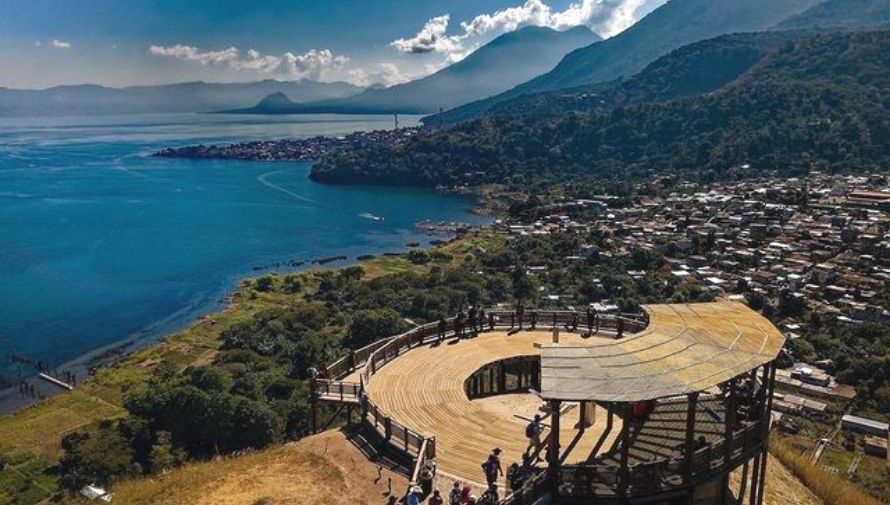
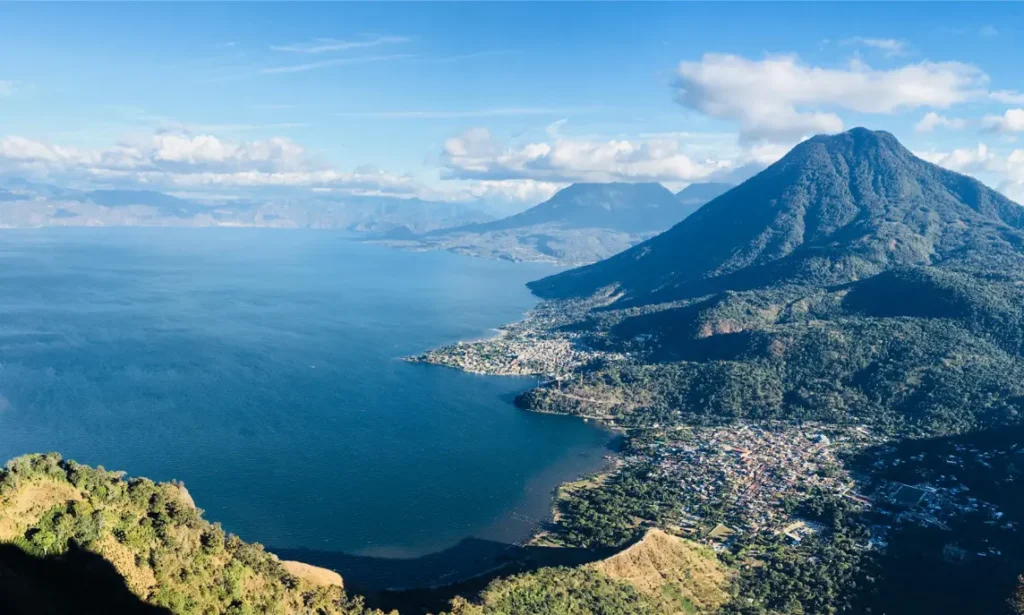
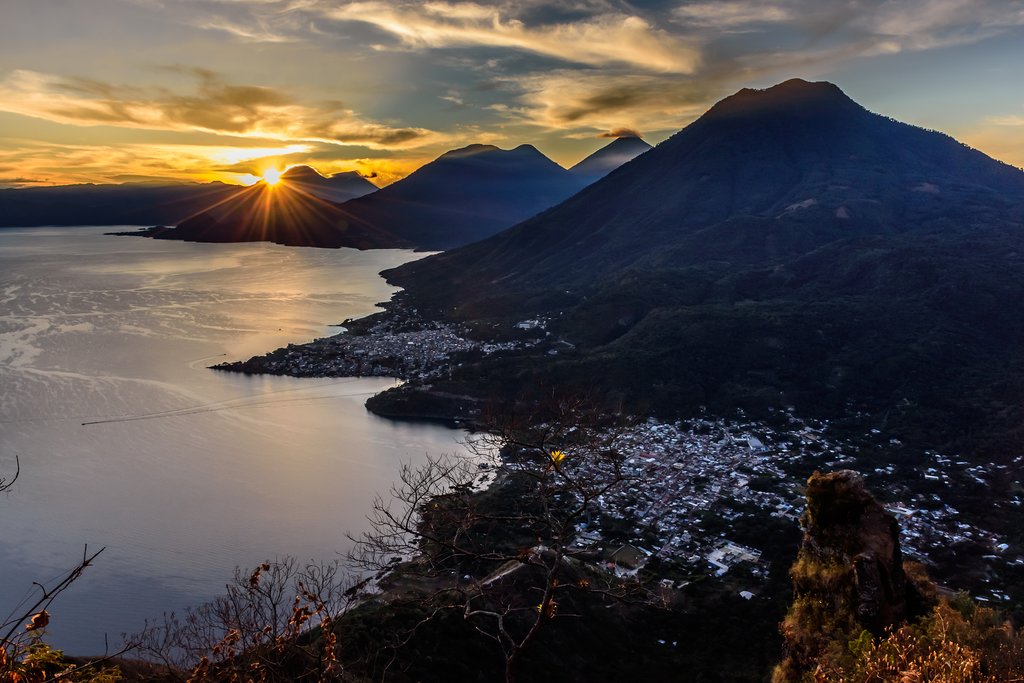
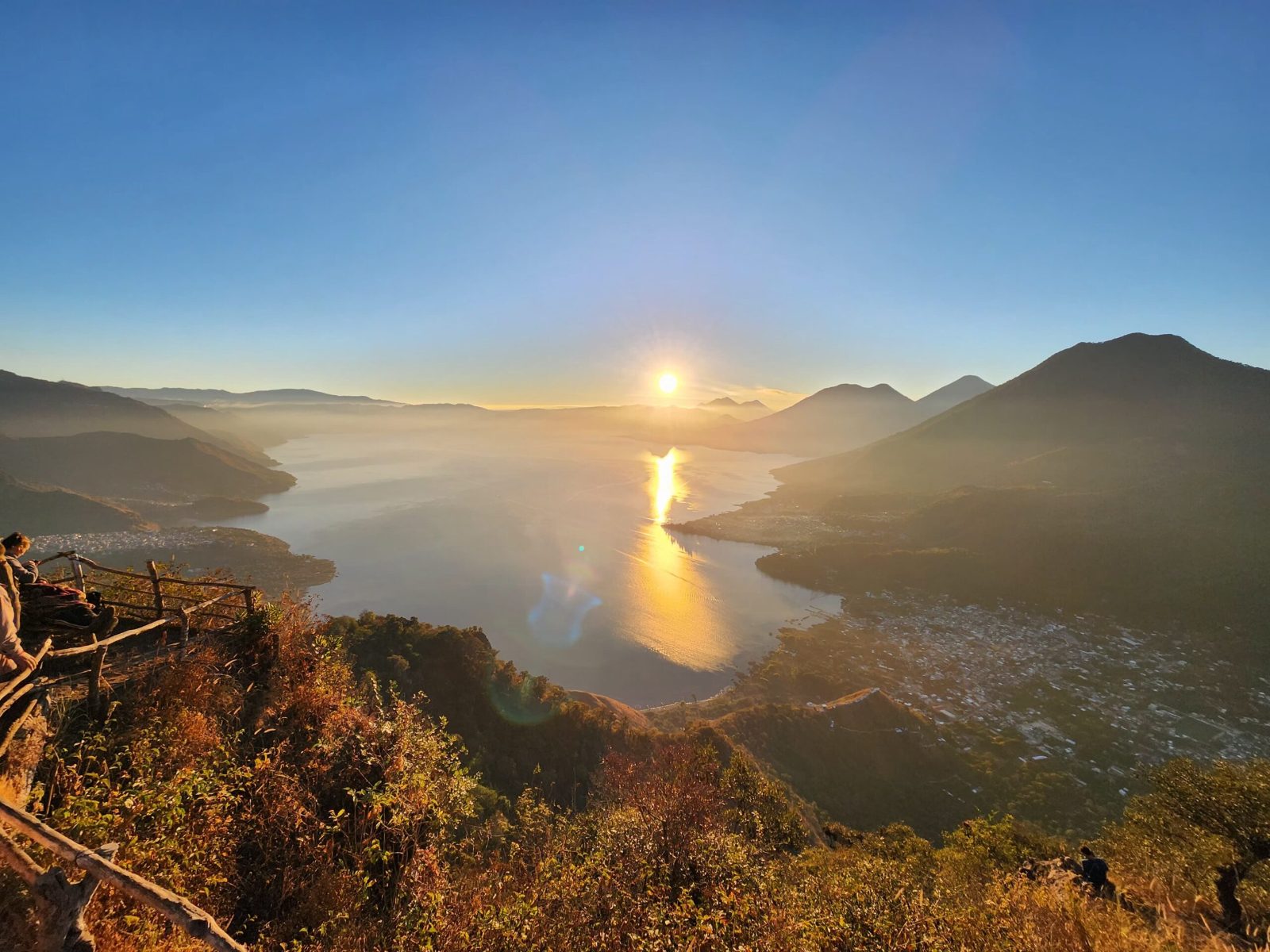
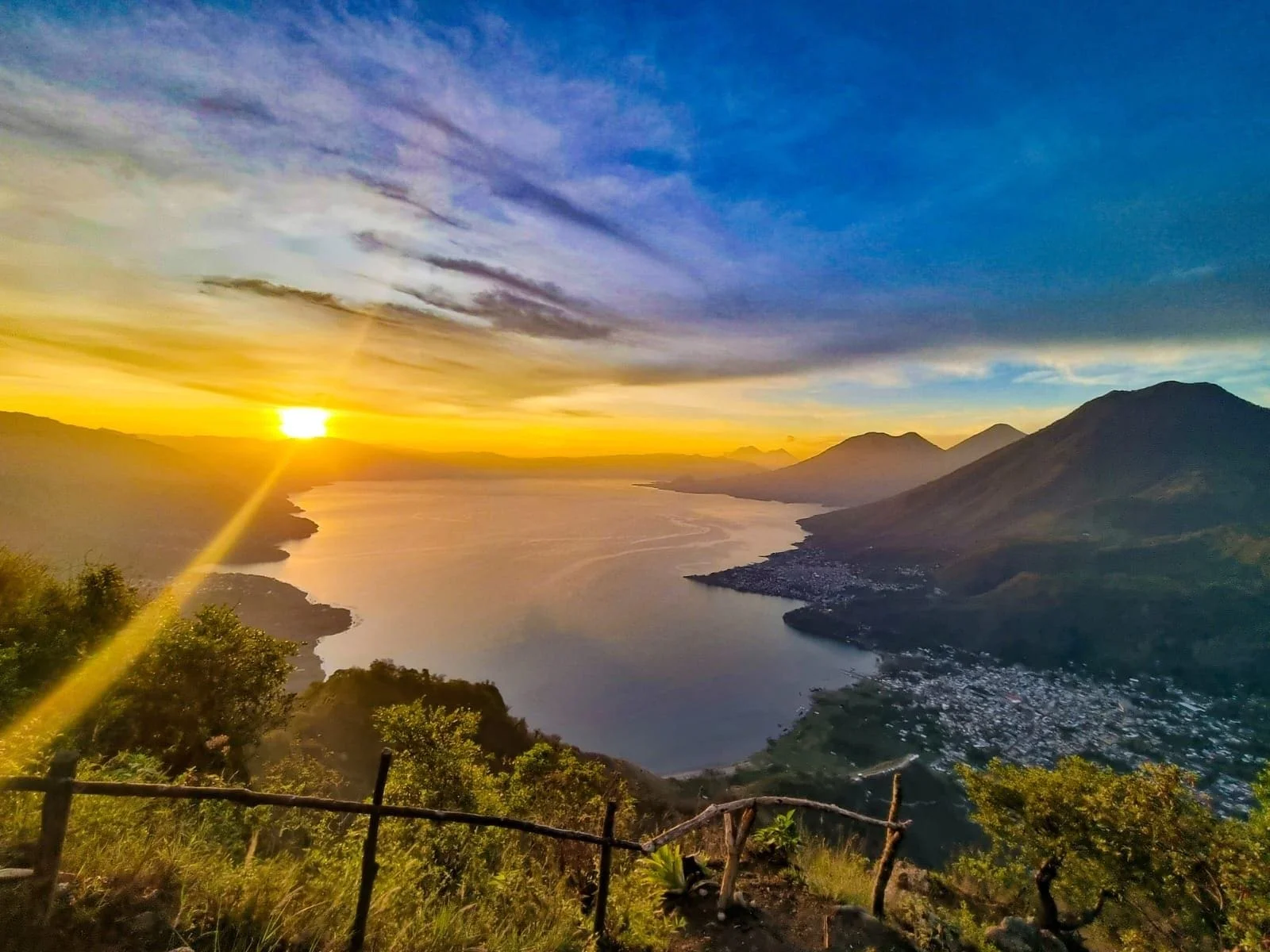
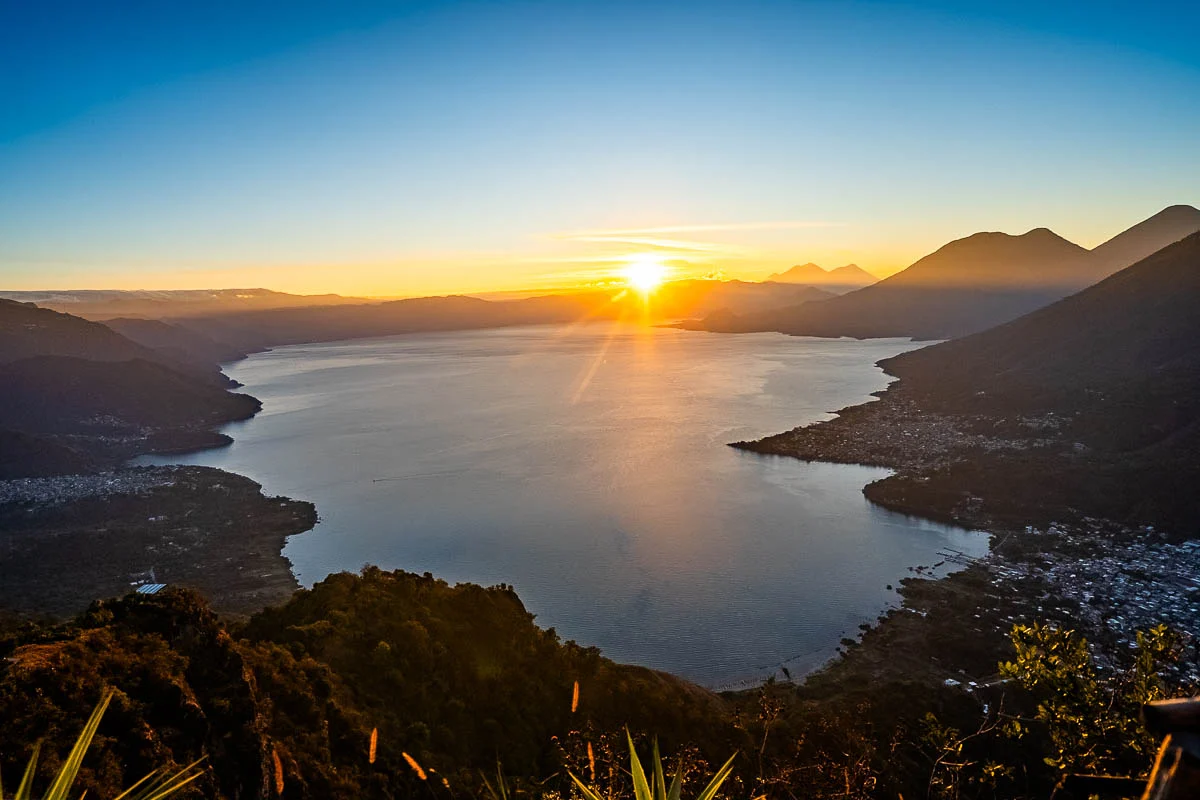
From the upper lookout, the lake opens into a broad basin framed by volcanoes and surrounding villages. The changing dawn light is the reason many guides start before 5:00 a.m., when contrast and cloud texture are strongest.
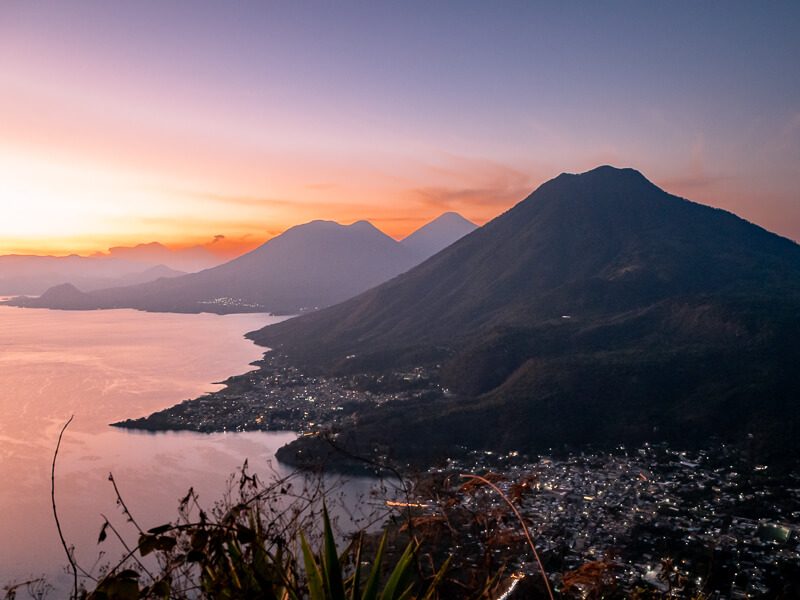
The horizon view is one of the hike’s strongest visual features, especially when the sky is clear and the volcanoes appear in layered silhouette. The scene rewards an early start because the first colors often last only a short window before the sun rises higher.
You leave the lakeshore in the dark with a headlamp on, while San Juan La Laguna is still shuttered and the street dogs are the only traffic. The road above the village narrows, then gives out.
At the control post you hand over 30 GTQ in cash, and the way turns to packed earth, pine needles and stone steps cut straight into the slope. You climb between coffee plots and oak, breathing harder than you expected. Forty minutes in, the trees open onto bare rock.
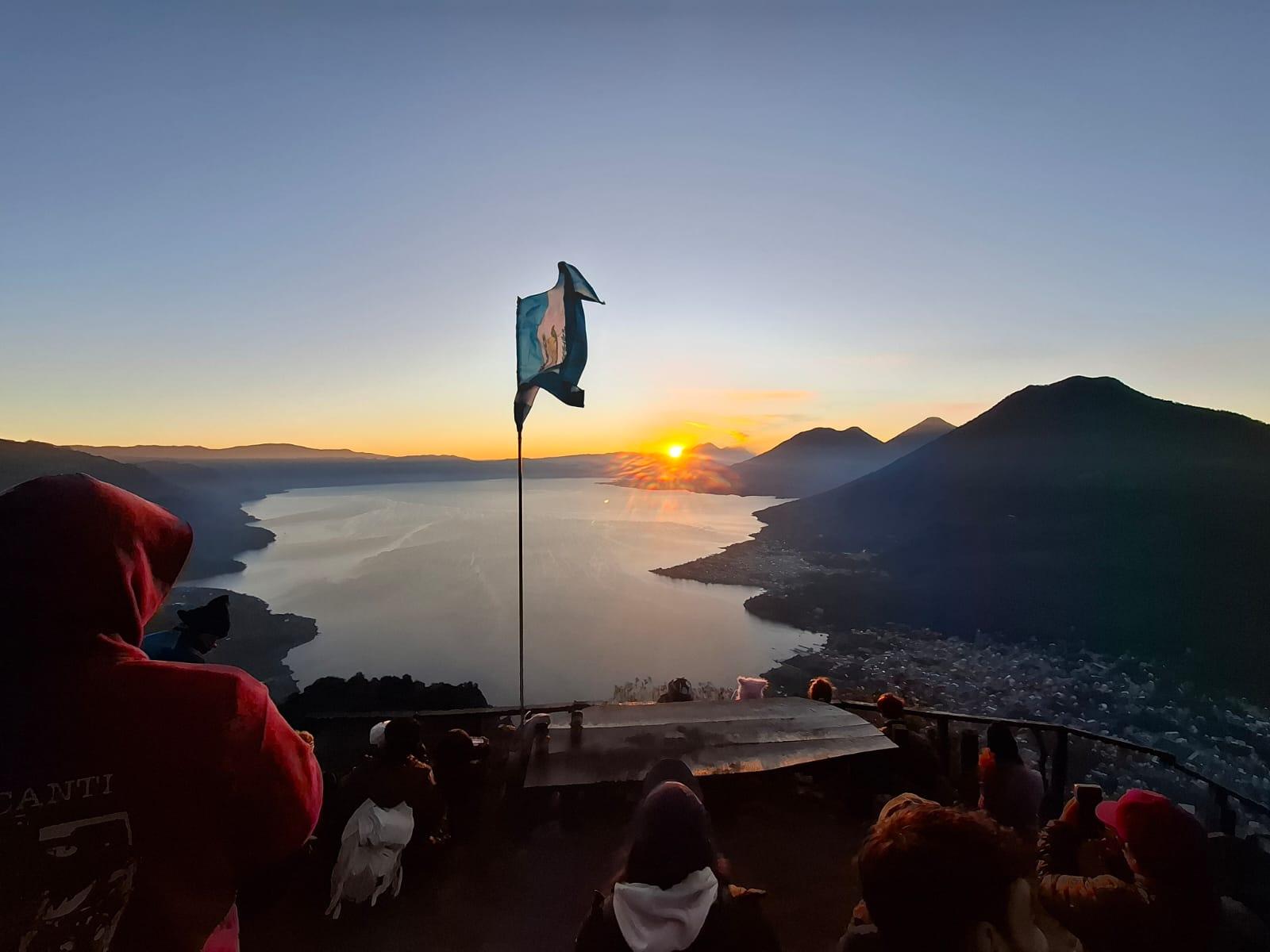
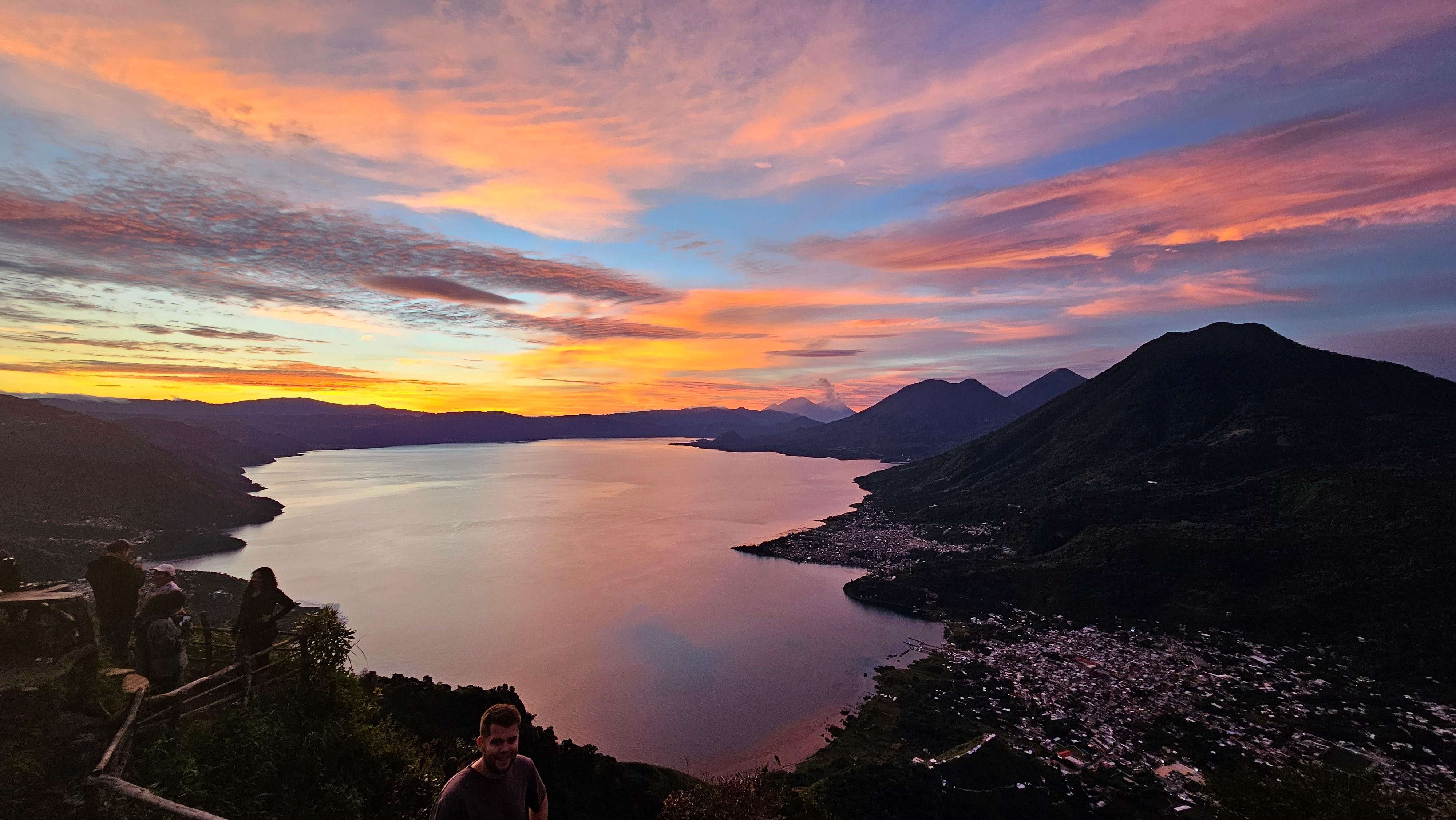
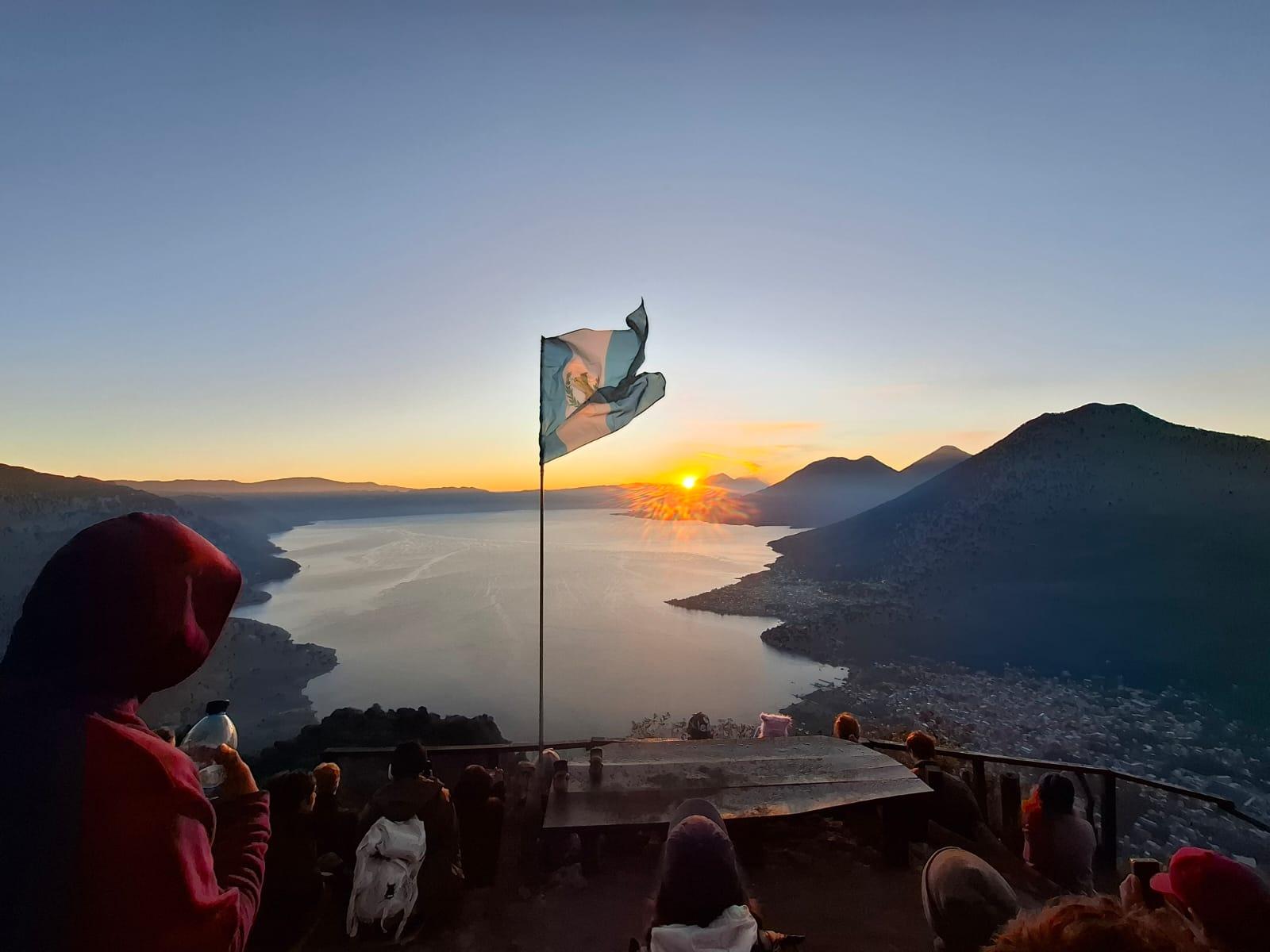
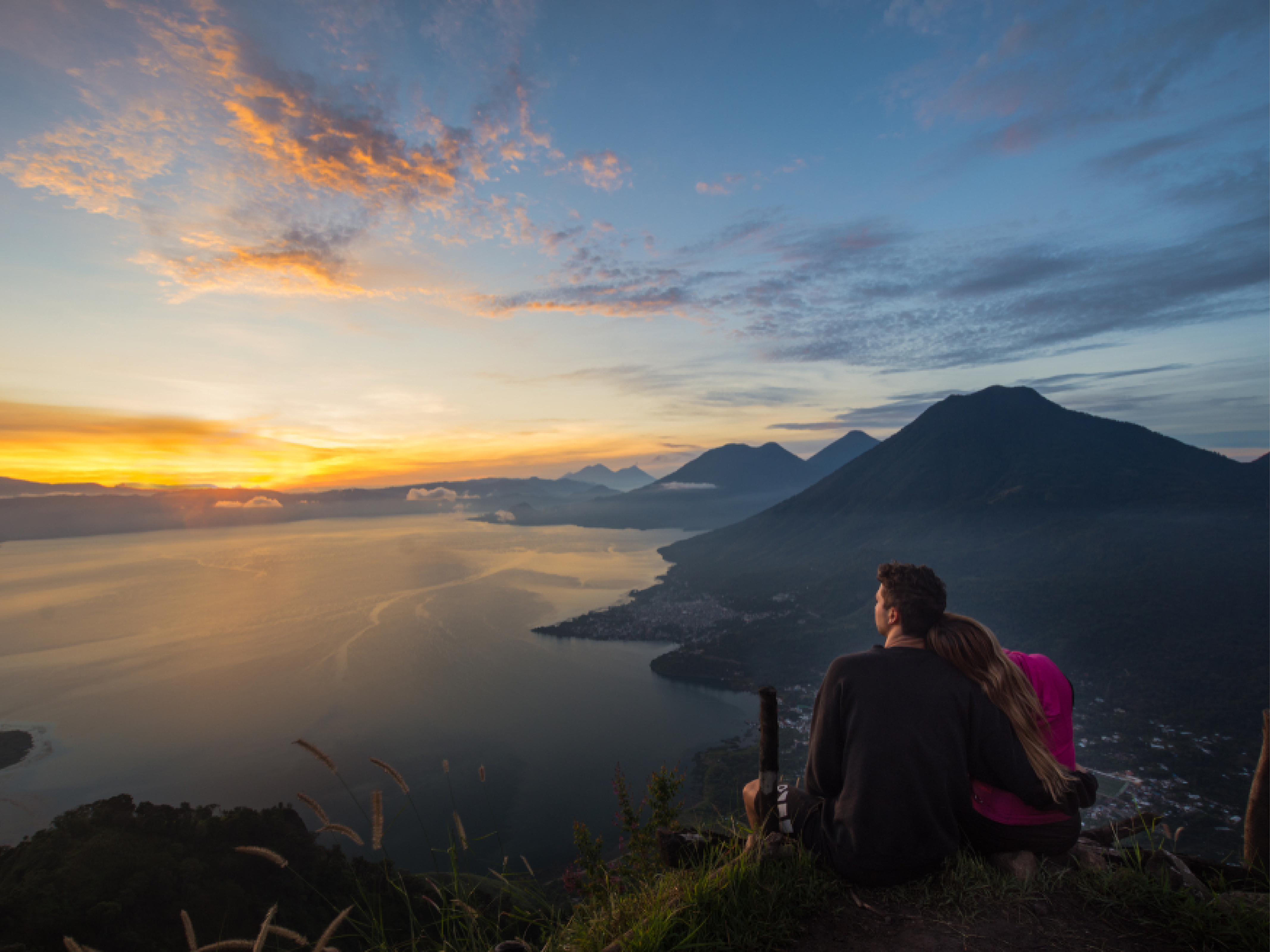
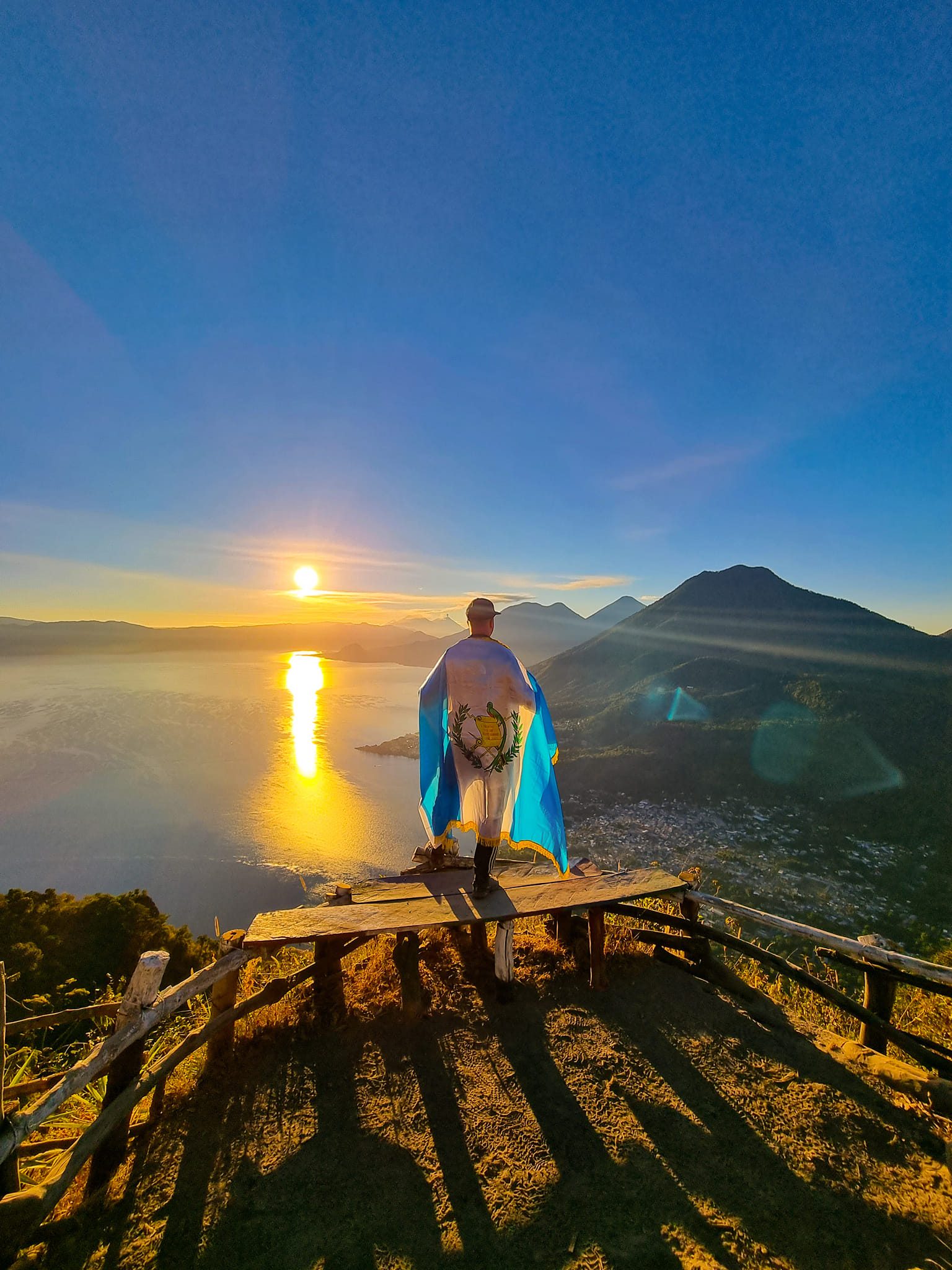
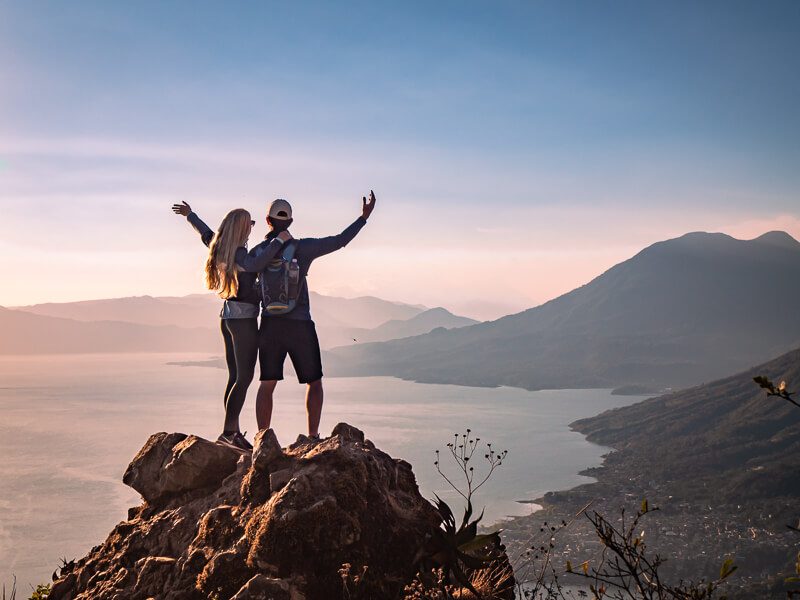
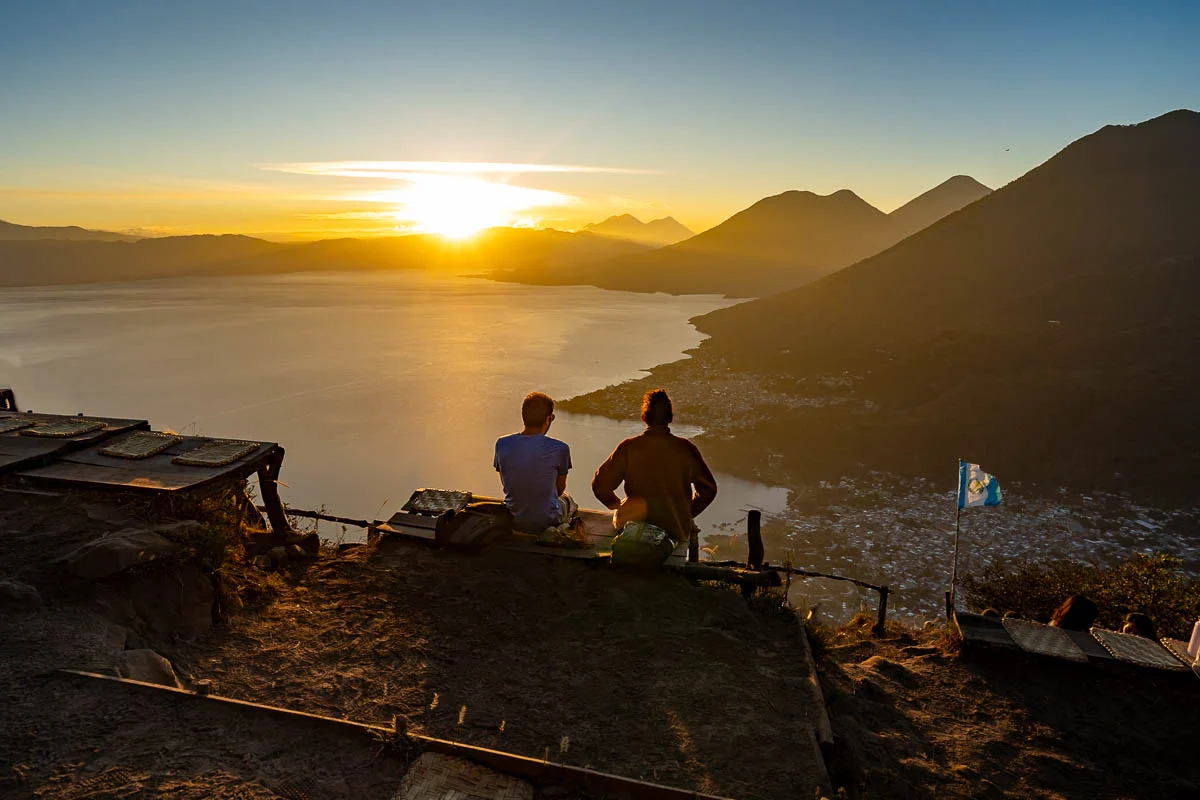
Best light falls between 04:30 and 06:00, so you reach the crest while it is still grey-blue and cold. Below, the caldera holds a flat sheet of cloud. You sit, pull your hands into your sleeves, and watch Volcán Tolimán and Volcán Atitlán separate from the dark, then San Pedro, then the far shore at Santiago. The sun touches the summits first and slides down them. Twelve villages switch on, one after another, and the boats begin to draw white lines across the water.
Most Indian Nose Sunrise Hike Tour tickets include pickup in San Juan, San Pedro or Panajachel, so the descent is unhurried. You go down through milpa and coffee terraces in full daylight, stop for a cup of something local, and are back at the dock while the morning is still cool.
All the details about your upcoming adventure in one place
Lake Atitlán fills the crater of a volcano that collapsed roughly 84,000 years ago, an eruption whose ash reached Florida and the floor of the Pacific. The ridge climbed on an Indian Nose Sunrise Hike Tour is part of that caldera's western rim, a wooded spine standing some 600 metres above the water at 1,562 metres.
Seen from Panajachel at dusk, the crest resolves into a human profile laid on its back: forehead, brow, nose, chin. The Tz'utujil Maya of San Juan La Laguna know it as Rostro Maya, the Mayan Face, and read the outline as an ancestor asleep beneath the sky rather than as a summit to be conquered.
The land is communal. Trails across the ridge fall under the municipalities of San Juan La Laguna and Santa Clara la Laguna, and the 30 GTQ trail fee collected at the gate is directed toward path maintenance, forest patrol and the village guide associations. Guatemala's highland pine and oak forest sits under steady pressure from firewood cutting and the advance of milpa cornfields, and the fee functions as a small, visible instrument of conservation. That arrangement shapes how Indian Nose Sunrise Hike Tour tours are run today: as community concessions held by the villages below, not as private franchises operating from the capital.
Altitude supplies the drama. The Sololá highlands sit within the Central American volcanic arc, and the crest is high enough to hold cold air until first light, while the caldera beneath it traps a sheet of cloud through the night. Guides on any Indian Nose Sunrise Hike Tour tour are usually Tz'utujil speakers raised in the coffee terraces on the slope, and their vocabulary for the view is inherited rather than learned from a script. From the exposed rock the three great cones stand in sequence: Volcán San Pedro, Volcán Tolimán and Volcán Atitlán, the last of them reaching 3,537 metres.
Twelve principal villages ring the shore below, each with its own dialect, weaving tradition and patron saint. Santiago Atitlán faces the far bay; San Marcos and Santa Cruz hold the northern cliffs; Panajachel spreads across the delta of the Río Panajachel. That geography is legible in a single sweep from the ridge, which is why the Indian Nose Sunrise Hike Tour has become the defining vantage point of the Guatemalan altiplano, and why the profile appears on so much of the region's printed material, from municipal seals to coffee sacks bound for export.

The Tz'utujil did not name a mountain; they named a face, and set it to sleep facing the sky.
Wear closed-toe hiking shoes with grip, a warm layer for pre-dawn temperatures, and clothing you can hike in comfortably. The route is short but steep in sections, so avoid sandals and loose clothing that can snag on brush.
Keep bags small and hands free for the climb; a compact daypack is enough for water, a light layer, and a phone. Guides and local fee points may be present on the trail, so carry cash for the 30 GTQ trail fee and keep valuables secured.
Photography is allowed on the trail and at the viewpoints, and sunrise is the main draw for most visitors. Use a low-light setting or tripod if you have one, but avoid blocking narrow paths or the viewing ledges while taking pictures.
Families with older children who already hike comfortably can do the trail, but very young children may struggle with the steep sections and pre-dawn start. If you travel with kids, start early enough to avoid rushing and plan for a slower descent.
This is a steep mountain hike, not an accessible viewpoint, and it is not suitable for wheelchairs or strollers. The trail is commonly described as short but physically demanding, with uneven steps and early-morning darkness.
Bring water and a light snack, since the sunrise outing begins before most local cafés are open. Some tours include coffee or tea after the hike, but that is operator-specific and not part of the trail itself.
Hours
Open daily 00:00–23:59
Address
Indian Nose, San Juan La Laguna, Sololá Department, Guatemala
Access
Steep trail; guide advised
Best arrival
04:30–06:00 for sunrise light
Trail fee
30 GTQ per person
If your booking is cancelled at least 24 hours before departure, you receive a full refund. Cancellations made within 24 hours are non-refundable; the 30 GTQ trail fee is separate from operator cancellation terms.
Recommended time
4-5 hours
For the indian nose sunrise hike tour, plan on about 4 to 5 hours end to end, even though the hike itself is usually much shorter than the full outing. That buffer covers the pre-dawn transfer, the climb to the viewpoint, a brief sunrise stay, and the walk back down without rushing. If you are starting from San Juan La Laguna and want a calmer experience, allow extra time for the earliest pickup and the first-light queue at the trailhead. The busiest moment is the sunrise arrival window; after the sun clears the horizon, the viewpoint usually feels less crowded within the next 20 to 30 minutes.
Crowd levels through the day
The ridge came first. Roughly 84,000 years ago the Los Chocoyos eruption emptied a magma chamber and left the caldera that now holds Lake Atitlán; San Pedro, Tolimán and Atitlán volcanoes rose later inside it. On the western rim stood a long escarpment whose silhouette, seen from the water, reads as a reclining face. Tz'utujil and K'iche' speakers call it Rostro Maya; Spanish gave it Nariz del Indio. Tradition reads the profile as an ancestor at rest. That reading still shapes how guides in San Juan La Laguna present indian nose sunrise hike tour tours. Foreign attention came late. Aldous Huxley published Beyond the Mexique Bay in 1934, judging Atitlán "really too much of a good thing" and fixing the lake among Guatemala's best-known landmarks. The crest itself stayed agricultural, terraced for maize and coffee. The armed conflict of 1960–1996 then closed the highlands of Sololá to casual travel for a generation. The Peace Accords of December 1996 reopened them. Only afterwards did a guided San Juan La Laguna sunrise hike become a trade rather than an errand, and the modern indian nose sunrise hike tour tour took shape. Recovery was twice tested. Hurricane Stan in October 2005 and Tropical Storm Agatha in May 2010 drove landslides through the basin, cutting footpaths and access roads. Rebuilding brought the summit trails under community management by San Juan and Santa Clara La Laguna, with upkeep funded by a trail fee now set at 30 GTQ per person. San Juan's designation as a Pueblo Mágico in 2019 confirmed the turn toward organised tourism alongside its natural-dye textile cooperatives. The closures of 2020 emptied the ridge entirely; by 2026, demand for indian nose sunrise hike tour tickets has recovered. What survives is the older arrangement: a worked hillside, coffee terraces, and a face in the rock above the Tz'utujil shore.
The Los Chocoyos eruption collapsed the Atitlán caldera, leaving the western ridge later known as Rostro Maya.
Aldous Huxley's Beyond the Mexique Bay placed Lake Atitlán before an international readership.
Guatemala's armed conflict restricted travel across the Sololá highlands for a generation.
The Peace Accords reopened the highlands and lake tourism gradually resumed.
Hurricane Stan and Tropical Storm Agatha triggered landslides that damaged trails and access roads around the basin.
San Juan La Laguna was designated a Pueblo Mágico by Guatemala's tourism authority.
Pandemic border closures halted hiking on the ridge for much of the year.
Access remains under community management, funded by a trail fee of 30 GTQ per person.
This is the main hero-frame for the indian nose sunrise hike tour: stand on the summit ledge and shoot the full Lake Atitlán basin with San Pedro, Tolimán, and Atitlán volcanoes lined up behind the water. The best composition is a wide horizontal frame; keep a little foreground rock for scale and expect the crowd to cluster here at sunrise.
Upper final-approach rock outcrop
Sunrise-facing summit edge
Crowd-free side shoulder
The indian nose sunrise hike tour is best for families with older kids who can handle an early start and a short but steep uphill walk in the dark. There are no stroller-friendly sections on the trail, so plan on carrying infants or skipping it with very young children.
Not suitable: the hike is on a mountain trail, so a stroller will not work. Bring a child carrier if you are traveling with a toddler, and keep hands free for the early-morning climb.
Best for school-age kids and teens who are steady on uneven ground. Multiple recent guides describe the route as short but steep, with about 30-40 minutes of hiking before sunrise.
Expect a simple trailhead, not family facilities. I could not verify baby-change rooms or dedicated family amenities, so plan for a quick, self-contained start before dawn.
The best arrival window is 04:30–06:00 for sunrise light, and the entrance fee is 30 GTQ per person. Build in extra time if your children need stops, since the trail is compact but climbs quickly.
Bring water and a small snack before you leave San Juan La Laguna, because early departures usually happen before breakfast service starts. After the hike, keep the rest of the morning light so younger kids can recover.
For an indian nose sunrise hike tour, the easiest food plan is simple: eat before the pre-dawn start, then use San Juan la Laguna cafés after you come down. Verified options near the trail base are concentrated in town rather than on the ridge, so most hikers plan a post-hike breakfast or coffee stop within a short walk or tuk-tuk ride.
Open until 6:00 PM and good for breakfast, brunch, or a late coffee after the hike. Reviews mention a welcoming space, garden seating, and filling plates, though it can feel busy around meal peaks.
A practical stop for espresso, breakfast, or a relaxed brunch before or after the trail. It is a known coffee stop in San Juan la Laguna and suits hikers who want something quick but not rushed.
Best for coffee and a light breakfast once you are back in town. Travelers describe it as a convenient stop from the dock, which makes it easy to fit around the indian nose sunrise hike tour flow.
A straightforward option for a fuller meal if you want to linger after sunrise. It is frequently listed among the closest restaurants to Indian Nose and works well for a calm late breakfast.
A longer, sit-down choice for a proper meal after the hike. It is a real San Juan venue with long-running local presence, so it suits visitors who want to turn the morning into a fuller meal stop.
Good for a lighter lunch after the climb, especially if you want something simple and meat-free. It is one of the better-known dining options in San Juan la Laguna and works well when you are not in a rush.
Everything you need to know for your journey
The trail is open daily from 00:00–23:59, but the best arrival window is 04:30–06:00 for sunrise light. If you want the classic experience, arrive early enough to be on the trail before first light. The entrance fee is 30 GTQ per person as a trail fee. That fee is separate from any guide or transport cost. No. The hike is steep and uneven, so it is not suitable for wheelchairs or strollers. A guide and sturdy shoes are strongly recommended for the climb. Wear closed-toe hiking shoes, a warm layer, and clothes you can move in easily. The start is before sunrise, so mornings can feel cool even when the day later warms up. Yes, bring water and a light snack. The trail itself does not provide food, although some tours include coffee or tea after the hike. For sunrise, plan around the 04:30–06:00 arrival window. That timing gives you enough margin to reach the viewpoints before the light changes. From San Juan La Laguna, the trail is accessed by local pickup or a short transfer to the trailhead; the attraction address is Indian Nose, San Juan La Laguna, Sololá Department, Guatemala. Many visitors use a guide because the route is steep and early-morning logistics are easier with transport. Older children who already hike comfortably can usually manage it, but the pre-dawn start and steep sections can be difficult for young kids. Families should plan for extra time and bring layers, water, and a small snack. Yes, photography is allowed and sunrise is the main reason most people go. Use care on narrow viewpoints so you do not block the trail or edge. If your booking is cancelled at least 24 hours before departure, you receive a full refund. Cancellations within 24 hours are non-refundable, and the 30 GTQ trail fee is separate. San Juan La Laguna is the most natural add-on, especially for breakfast or coffee after sunrise. Santa Clara La Laguna and San Pedro La Laguna are also common nearby bases for Lake Atitlán itineraries.
Please contact us for more information.
Join thousands of happy travelers who have discovered this incredible experience
Book Your Experience Now